
Project Cost Management in the Automotive Industry
Managing costs in automotive projects is no small feat. Between complex supply chains, high R&D investments, and strict regulatory requirements, project managers in the automotive industry face unique challenges when it comes to budgeting. Effective project cost management isn’t just about keeping expenses under control, it’s about ensuring that innovation, compliance, and profitability can coexist. In the time of huge cost pressure for all companies, small or big, this seems like a mission impossible.
In this section I will put my focus to Automotive projects. Those often involve large-scale investments in prototyping, tooling, and testing. R&D costs can reach from 100k to 100m. A single miscalculation in budgeting can ripple across the entire project, leading to delays, quality issues, or even regulatory setbacks. With global competition and rapidly evolving technologies, cost management becomes a strategic advantage. With so little tools adopted to requirements in real projects, the budgeting and tracking can become a mess. Often Project Managers are not owners of the budget, but pure executioners of the Scope, that can have a negative impact to the complete company.
What Is Project Cost Management?
Project cost management is the discipline of estimating, allocating, and controlling costs throughout the project lifecycle. It typically involves three key stages:
Cost Estimation – Predicting expenses based on scope, resources, and historical data.
Budgeting – Allocating funds across categories and setting financial baselines.
Cost Control – Monitoring actual spending against the budget and making adjustments when necessary.
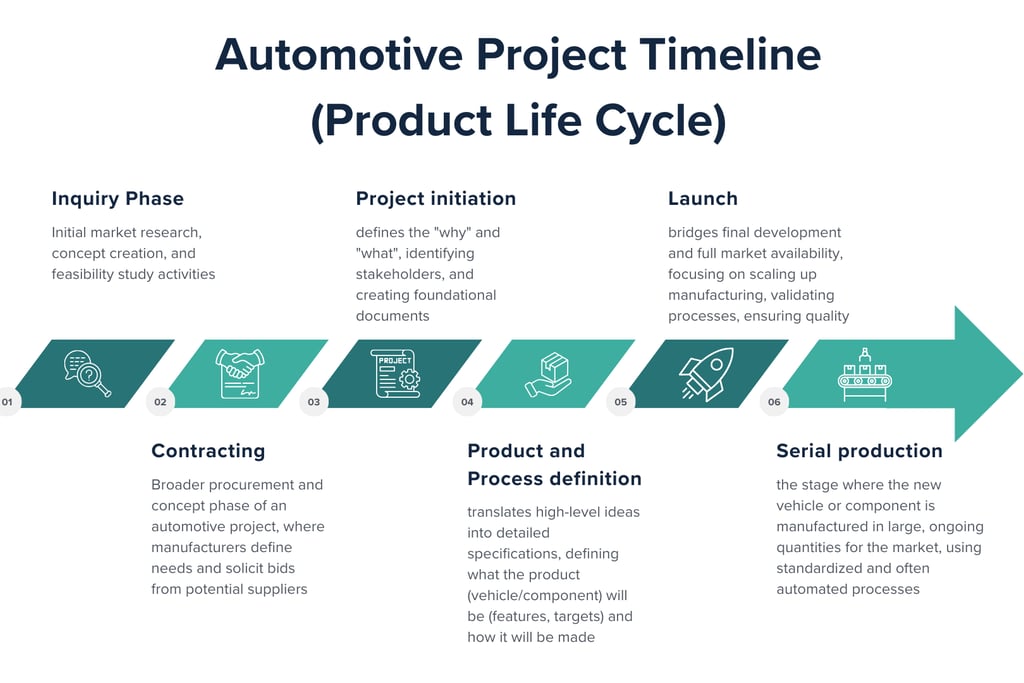
In automotive projects, these stages must account for variables like fluctuating material prices, supplier reliability, and compliance costs. In the Product Life Cycle the Cost Estimation phase is set in Inquiry Phase, the Budgeting is done with Project initiation, while the Cost control is done trough the Product / Process defintion and Launch phase.
Unique Challenges in Automotive Projects
When people think of automotive projects, they often imagine sleek cars rolling off assembly lines or futuristic prototypes unveiled at auto shows. What’s less visible is the intricate web of challenges that make these projects uniquely demanding. Unlike many industries, automotive development sits at the intersection of engineering, technology, regulation, and human expectation and that makes the road anything but smooth.
One of the biggest hurdles is regulation. Cars aren’t just consumer products; they’re machines that operate in public spaces where safety is paramount. Every new model must pass rigorous crash tests, emissions checks, and now even cybersecurity standards. And because rules differ across regions, a vehicle designed for Europe may need significant adjustments before it can be sold in North America or Asia. This constant juggling of compliance requirements adds layers of complexity that few other industries face.
Technology is another pressure point. Today’s vehicles are no longer defined solely by horsepower or fuel efficiency. They’re rolling computers, packed with sensors, AI-driven driver assistance, and connectivity features. Integrating these systems isn’t just about innovation — it’s about reliability. A glitch in a smartphone app might be annoying; a glitch in a braking system could be catastrophic. Automotive projects demand a level of precision and cross-disciplinary collaboration that stretches teams to their limits. Then there’s the supply chain. A single car can contain thousands of parts sourced from suppliers around the globe. If one critical component say, a semiconductor chip becomes unavailable, entire production lines grind to a halt. Recent years have shown how fragile these networks can be, with geopolitical tensions and global crises exposing vulnerabilities that ripple across the industry. Project managers in automotive don’t just plan; they prepare for disruption as a constant companion. Cost and time pressures add another layer. Developing a new vehicle can take years and billions of dollars, yet market competition pushes companies to deliver faster and cheaper. Consumers expect cutting-edge features without skyrocketing prices, forcing teams to balance innovation with affordability. It’s a tightrope walk where missteps can mean losing ground to rivals.
Sustainability has also become a defining challenge. The shift toward electric vehicles isn’t simply a matter of swapping engines for batteries. It requires new infrastructure, new materials, and new ways of thinking about recycling and energy use. Automotive projects now carry the weight of environmental responsibility, with companies judged not only on performance but on their contribution to a greener future.
And let’s not forget the human side. Customers want cars that feel personal with smart features, eco-friendly options, even customization. Delivering that sense of individuality at scale is no small feat. Meanwhile, global teams working across cultures and time zones must coordinate seamlessly, often under immense pressure. Miscommunication can derail progress just as easily as a faulty part.
Finally, the specter of recalls looms over every project. Even minor defects can trigger massive recalls, costing millions and eroding trust. With autonomous and connected vehicles, the stakes rise even higher: a software bug isn’t just inconvenient, it could be dangerous. That risk forces automotive projects to adopt some of the most rigorous testing and quality assurance practices in any industry.
In the end, automotive projects are about more than building cars. They’re about navigating a landscape where technology, regulation, sustainability, and human expectation collide. The challenges are immense, but so are the rewards. Each successful project doesn’t just put a vehicle on the road, it represents a triumph over complexity, a testament to resilience, and a glimpse into the future of mobility.
COntact
info@theprojectsphere.com
© 2025. All rights reserved.