
Escalation Management in Projects: Why It Often Fails
Escalations are supposed to be the safety net of project management—a structured way to raise issues that cannot be resolved at the team level. Yet in reality, they often fail spectacularly. Instead of being a mechanism for resolution, they become a source of frustration, delay, and mistrust.
Common Causes of Escalation in Project Management
Escalations can arise at any stage of a project. While they are meant to ensure timely resolution of issues, the underlying causes often reveal gaps in planning, communication, or execution. Here are the most frequent triggers:
Communication Breakdowns Poor or insufficient communication is one of the leading causes of escalation. Misunderstandings, missing information, or unclear updates can lead to wrong decisions and costly delays.
Interpersonal Conflicts Projects bring together diverse personalities, perspectives, and working styles. When disagreements escalate beyond healthy debate, they can disrupt collaboration and require intervention from higher levels.
Unclear Responsibilities Ambiguity around roles and ownership often results in tasks being overlooked or duplicated. Without clear accountability, problems accumulate until escalation becomes unavoidable.
Resource Bottlenecks Competing priorities across multiple projects can stretch resources thin. When teams lack the capacity or tools to deliver, escalation is often the only way to secure additional support or reallocate workloads.
Schedule Delays Missed milestones or deadlines can stall the entire project. These delays often stem from poor risk management during planning and may require leadership intervention to reset timelines or reprioritize tasks.
Changing Requirements Scope creep or sudden shifts in client expectations can significantly impact deliverables. Escalation ensures that changes are reviewed and approved at the right decision-making level.
Technical Issues Unexpected technical challenges—whether in software, hardware, or processes—can jeopardize progress or quality. Escalation helps mobilize expertise and resources quickly to find solutions.
Budget Overruns When costs exceed forecasts and internal adjustments aren’t enough, escalation is necessary to secure additional funding or make tough trade-offs.
Contractual or Supplier Problems External dependencies can introduce risks. Disputes with vendors, subcontractors, or partners that threaten delivery often require escalation to protect project outcomes.
The Ripple Effect of Poor Escalations
When escalations fail, the consequences ripple across the project:
Delays: Critical decisions stall, pushing timelines further out.
Eroded Trust: Stakeholders lose confidence in the team’s ability to manage challenges.
Low Morale: Team members feel unsupported, demotivated, and reluctant to raise issues in the future.
Damaged Relationships: Escalations handled poorly can sour relationships between teams, managers, and clients.
What Good Escalation Management Looks Like
Lets look at how a proper escalation management looks like:
Clear Frameworks Define escalation paths upfront: who to contact, what qualifies as an escalation, and expected response times.
Solution-Oriented Leadership Management must take ownership of escalated issues. Even if the team is tasked with execution, leadership should provide guidance, resources, and authority to resolve the matter.
Proactive Communication Encourage teams to escalate early, before issues become crises. Normalize escalation as a constructive tool, not a sign of weakness.
Balanced Approach Train teams to distinguish between minor hiccups and genuine blockers. This ensures leadership attention is reserved for issues that truly require intervention.
Follow-Through Escalations should end with resolution, not recycling. Leadership must close the loop, ensuring the issue is addressed and lessons are captured for future prevention.
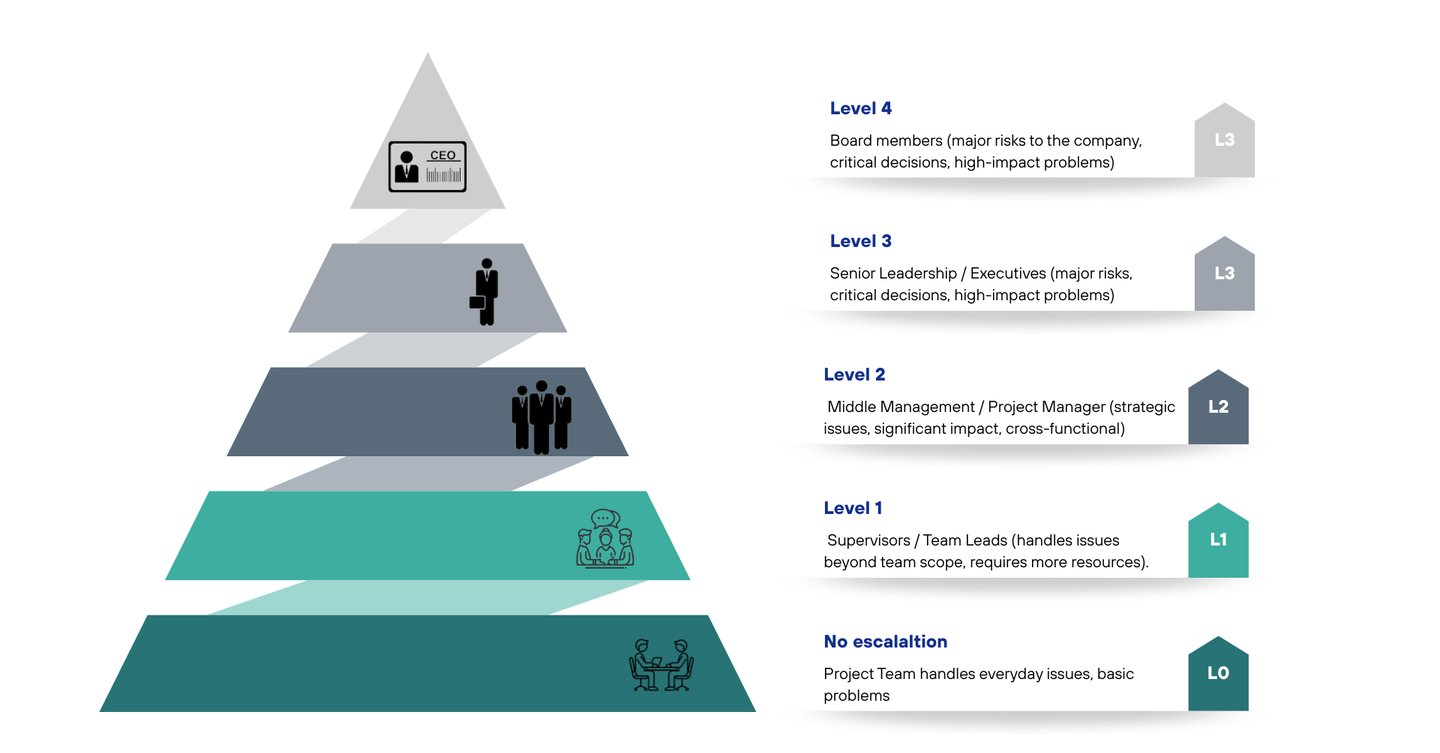
Escalation Pyramid
An escalation pyramid in project management is a hierarchical model showing communication levels for issues beyond a team's scope, moving from front-line staff (Level 1) up through supervisors, managers, and senior leadership (top). It provides clear "who handles what" guidelines, defining authority for solving problems, preventing bottlenecks, and ensuring timely resolution by only moving issues up when a lower level can't resolve them, using defined criteria like risk or cost.
Download our templates:
Steps for Successful Escalation in Project Management
1. Early Identification of Problems
Detect risks or conflicts before they grow.
Encourage team members to raise concerns quickly.
Use monitoring tools and regular check-ins to spot deviations early.
2. Clear Communication
Share the issue openly with all relevant stakeholders.
Avoid vague language—state the problem, its impact, and urgency.
Keep communication factual, not emotional, to prevent blame culture.
3. Defined Escalation Paths
Establish who to contact at each escalation level (team lead → project manager → steering committee).
Ensure everyone knows the chain of responsibility.
Avoid bypassing levels unless urgency demands it.
4. Involve the Right Decision-Makers
Escalation should reach those with authority to act.
Match the problem type (financial, technical, timeline) with the right expertise.
Prevent unnecessary overload of senior management by filtering issues.
5. Structured Documentation
Record the issue, escalation steps taken, and decisions made.
Documentation ensures transparency and accountability.
Helps prevent repeated mistakes and supports learning for future projects.
6. Timely Resolution
Escalation is not just reporting—it’s about solving.
Set deadlines for decisions and actions.
Track progress until the issue is fully resolved.
7. Follow-Up and Feedback
Confirm that corrective measures worked.
Provide feedback to the team to reinforce trust in the process.
Use lessons learned to refine escalation procedures.
In essence, successful escalation is not about passing problems upward—it’s about ensuring they are solved quickly, by the right people, with full transparency.
You can find more detailed description on the PLANTA site.
COntact
info@theprojectsphere.com
© 2025. All rights reserved.